New to Therapy?
If you've never been to therapy before, you're not alone in wondering what to expect.
You don't need a diagnosis or crisis to benefit from therapy. Many of my clients come in feeling stuck, overwhelmed, or simply wanting to understand themselves better. If you're asking this question, that curiosity is often a sign you're ready.
A therapist (like me, an LPCC) provides talk therapy and helps you work through emotions, patterns, and life challenges. A psychologist often focuses on assessment and may provide therapy. A psychiatrist is a medical doctor who can prescribe medication. Many people work with a therapist and psychiatrist together.
Yes, with a few legal exceptions. I'm required to break confidentiality only if there's imminent risk of harm to yourself or others, suspected abuse of a child or vulnerable adult, or a court order. We'll discuss this in detail during our first session.
That's completely normal. You don't need to arrive with an agenda. Sometimes the most meaningful sessions start with "I don't know where to begin." I'll help guide the conversation.
It depends on your goals. Some clients find clarity in a few months; others choose longer-term work to address deeper patterns. We'll check in regularly about what's working and when you feel ready to transition out.
Progress often shows up in small ways first—you might notice you're reacting differently to situations, feeling less stuck, or understanding yourself with more compassion. We'll talk about your goals early on so we can track what matters to you.
Fit matters. If something doesn't feel right, I encourage you to share that with me—it's useful information, not a failure. And if we're truly not the right match, I'll help you find someone who is.
I hold an M.S. from the University of Pittsburgh (2018) and am a Licensed Professional Clinical Counselor (LPCC, California #21011). I'm also a Certified Akashic Record Reading Healer. My clinical experience spans psychiatric hospitals, domestic violence shelters, community mental health centers, and private practice. I work with adults ages 17 to 65 from diverse cultural, professional, and international backgrounds, and I bring a multicultural lens to all my work. I especially support clients navigating identity, relationships, life transitions, and patterns that feel hard to break. I offer therapy in both English and Mandarin Chinese.
Understanding Your Mind
A few concepts that can help you make sense of what you're experiencing.
Your window of tolerance is the zone where you can handle stress and stay relatively grounded. When you're pushed outside this window, you might feel either overwhelmed and anxious (hyperarousal) or shut down and numb (hypoarousal). The good news: with support and self-care, your window can expand over time.

When your nervous system is in overdrive, you might experience restlessness, irritability, racing thoughts, difficulty concentrating, a pounding heart, or the urge to fight or flee. It's your body's alarm system working overtime.
This is the opposite—a state of shutdown. You might feel low energy, unmotivated, foggy, disconnected from your body, or emotionally flat. Some people describe it as "going through the motions" or feeling like they're watching life from behind glass.
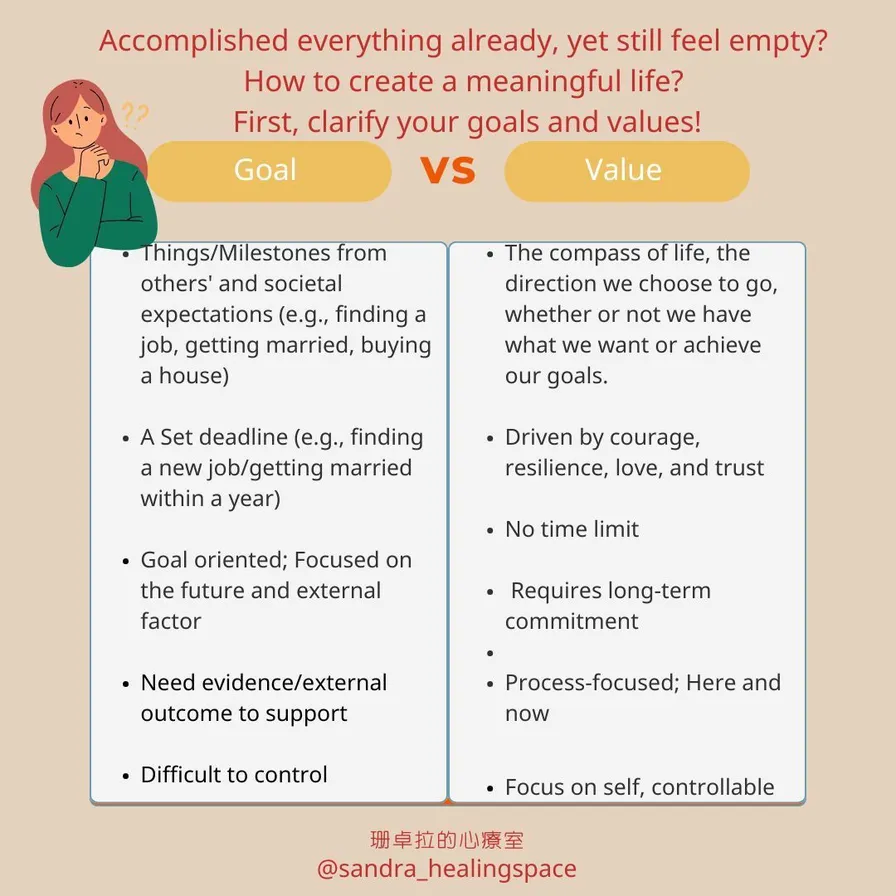
Goals are specific outcomes—getting a promotion, finishing a degree, finding a partner. They have endpoints and often depend on external factors. Values are how you want to show up in life regardless of outcomes—with courage, kindness, creativity, or integrity. Unlike goals, values don't have a finish line. They guide your direction even when circumstances are beyond your control. Many people accomplish their goals yet feel empty because they've lost touch with their values. Therapy can help reconnect the two.
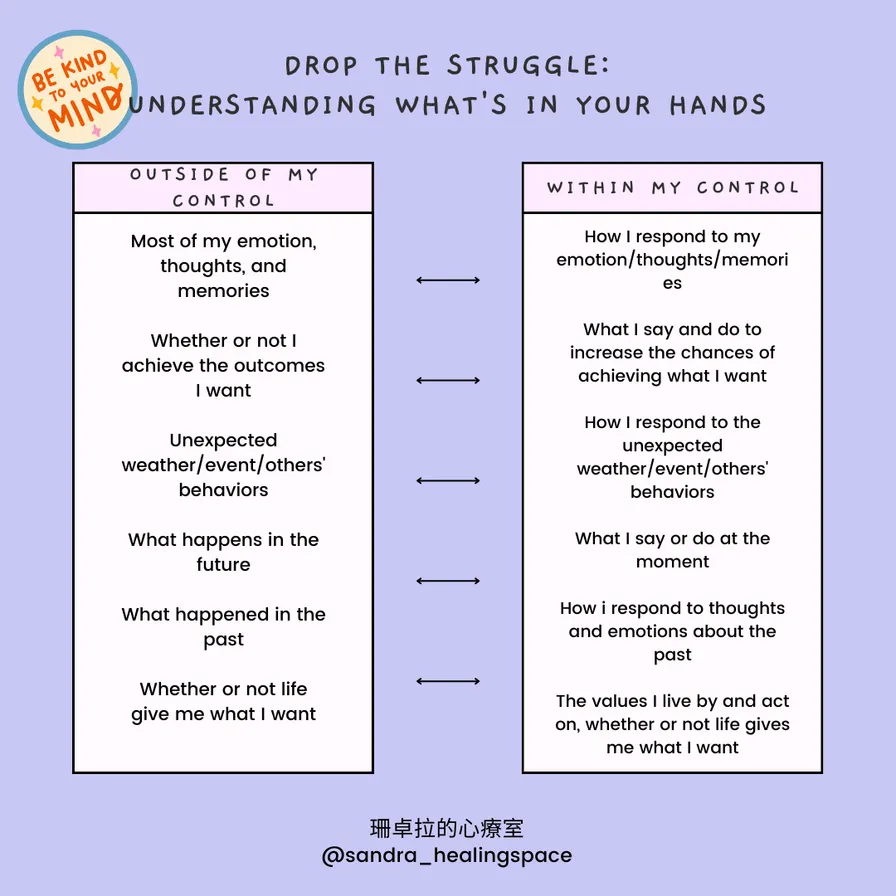
Less than we think—and more than we realize. You can't control your initial emotions, other people's behavior, or what life throws at you. But you can control how you respond, what actions you take, and the values you live by. Learning to focus energy on what's actually in your hands is one of the most freeing shifts you can make.
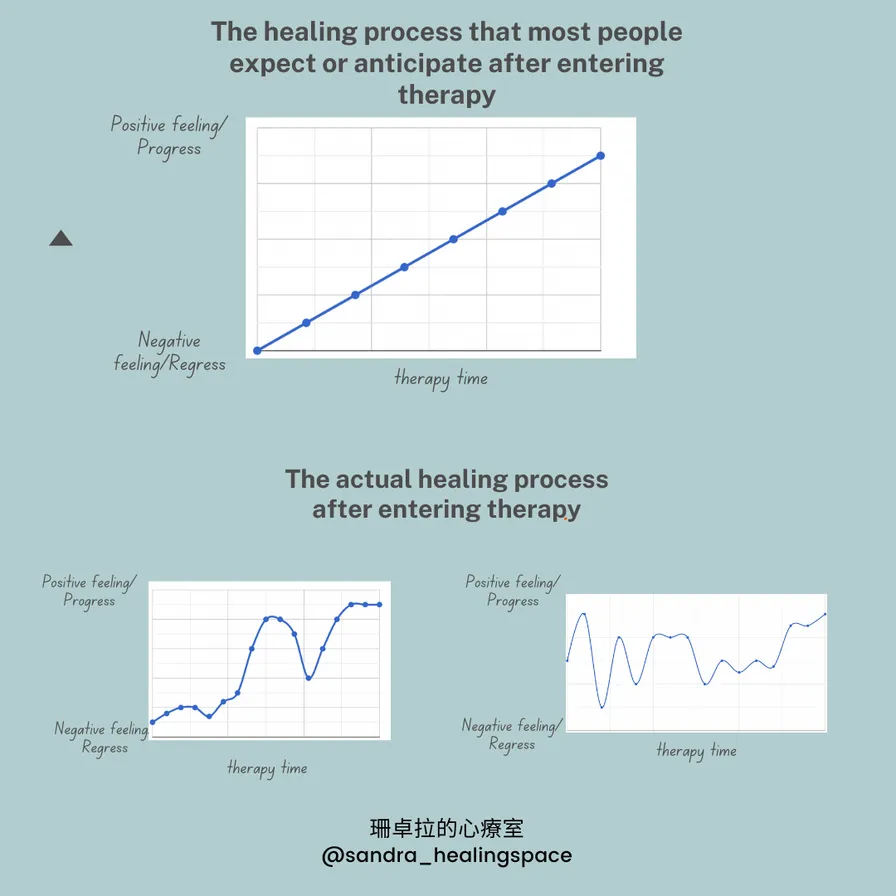
No. Most people expect steady improvement, but real healing has ups and downs. You might have a breakthrough one week and feel like you've regressed the next. This is normal—not a sign that therapy isn't working. Over time, the overall trend moves toward growth, even when individual days feel hard.
Grounding techniques can help bring you back to the present moment. Some options include meditation, journaling, connecting with nature, breathwork, movement like yoga or walking, or simply doing something that brings you peace. Even a few minutes can help regulate your nervous system.

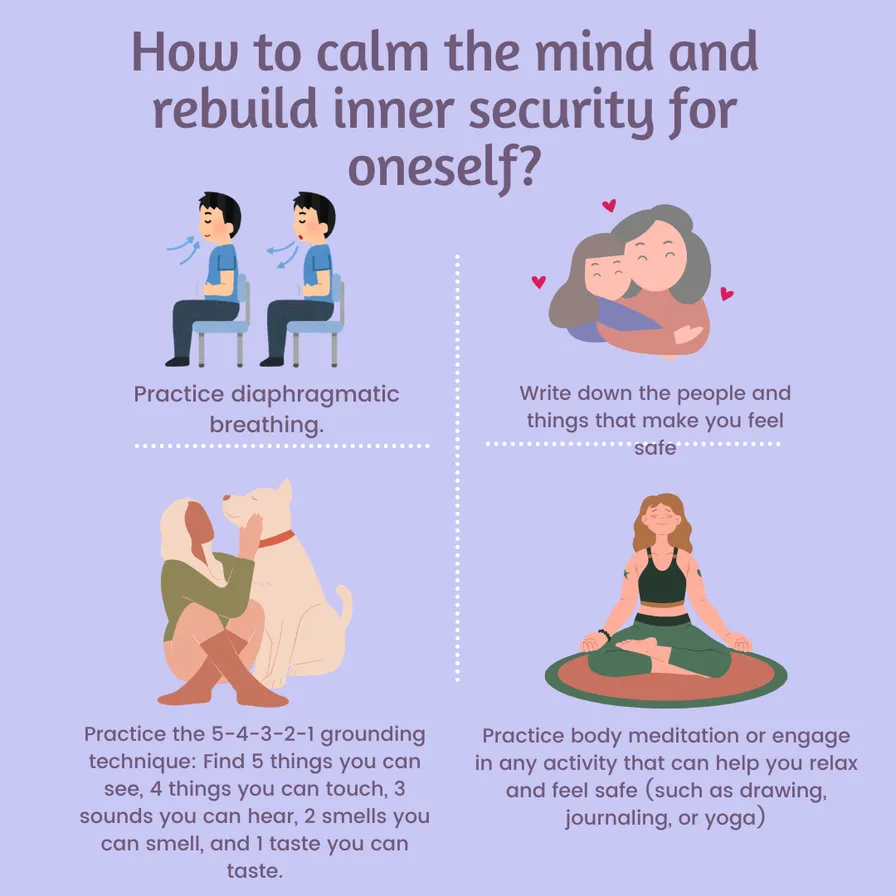
Building a sense of inner safety takes practice. Try diaphragmatic (belly) breathing to activate your calming nervous system. Write down the people and things that make you feel safe. Practice the 5-4-3-2-1 technique: notice 5 things you can see, 4 you can touch, 3 you can hear, 2 you can smell, and 1 you can taste. Body-based practices like meditation, drawing, or yoga can also help you feel more settled.
Sessions & Scheduling
What to expect when we work together.
It's a brief phone call where we both get a sense of fit. You can share what's bringing you to therapy, ask me questions, and see if my approach resonates. There's no pressure—it's just a conversation.
Just show up as you are. You don't need to have your thoughts organized or know exactly what you want to work on. If you have intake paperwork, I'll send that ahead of time.
Yes, most of my clients work with me online.
Sometimes, if it would be helpful. This might be journaling prompts, trying a new response in a difficult situation, or practicing a grounding technique. It's never busywork—only things that extend our session work into your daily life.
This is a spiritual practice I'm trained in, separate from clinical therapy. It's not part of standard sessions, but some clients are curious about exploring it as a complementary tool. We can discuss if it's something you're interested in—it's never required or expected.
Most clients start weekly. As you progress, we might shift to biweekly or monthly. We'll decide together based on what serves you best.
Fees & Insurance
Pricing, insurance, and payment details.
Individual sessions: $150. Couples sessions: $200. Sliding scale available based on financial need.
I'm in-network with Aetna, Anthem Blue Cross California, Blue Shield of California, Carelon Behavioral Health, Cigna, Horizon Blue Cross and Blue Shield of New Jersey, Independence Blue Cross Pennsylvania. For other insurance, please contact me directly to verify coverage.
It's a receipt with the codes your insurance needs to process a claim. You pay me directly, then submit the superbill to your insurance for possible reimbursement. I can walk you through this process.
Payment is due at the time of each session. I accept credit cards, HSA/FSA, PayPal, Venmo, and Zelle.
I ask for 24 hours notice if you need to cancel or reschedule. Late cancellations or no-shows may be charged the full session fee, with exceptions for emergencies.